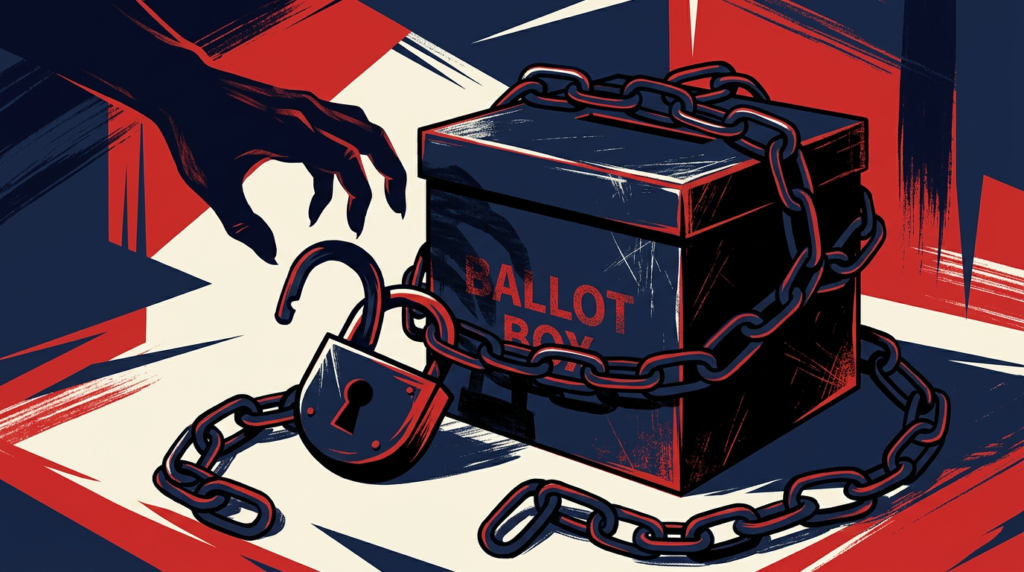
This week, on Newsmax host Wayne Allyn Root’s show, Root laid out a specific scenario directly to the president: since the SAVE America Act can’t get through the Senate, Trump should simply declare a “national security emergency for elections” instead — forcing through photo ID requirements, proof-of-citizenship registration, and mail-ballot restrictions by executive fiat, bypassing Congress entirely. Root’s pitch included the claim that such a declaration “can’t be challenged.” Trump’s response: “Let me just say that stranger things have happened, OK? I’ll leave it at that.”
That’s not a denial. It’s the deliberate, practiced non-answer of a president who wants the option left open and wants people to know he wants it left open.
THIS ISN’T A RANDOM COMMENT — IT’S THE THIRD SIGNAL IN A ROW
Context matters enormously here, because this exchange doesn’t stand alone. Two months ago, this newsletter covered Trump’s primetime “election security” speech — the one that promised proof of foreign interference and delivered none, per his own allies’ own admissions. Ty Cobb, who served as White House counsel during Trump’s first term, read that speech at the time as laying deliberate legal groundwork: a “predicate that he needs to declare an emergency.” The Washington Post separately reported in March that pro-Trump activists were already circulating a draft executive order — reportedly 17 pages — built around the claim that Chinese interference in the 2020 election grants Trump ongoing emergency powers over the 2026 election specifically. The Center for American Progress’s own tracking notes Trump told an audience in January, in his own words: “I won’t say cancel the election; they should cancel the election,” followed a week later by, “When you think of it, we shouldn’t even have an election.”
Three separate data points, over eight months, all pointing the same direction. That’s not one comment interpreted uncharitably — that’s a pattern.
THE LEGAL REALITY, STATED PLAINLY BY EXPERTS ACROSS THE POLITICAL SPECTRUM
Here’s the important caveat that any honest version of this story has to include: legal scholars are broadly skeptical this would actually work. UCLA election law professor Rick Hasen told The New Republic directly: “The United States Constitution does not give the president power over elections. We have a decentralized election system. Most of our election rules come from states, from state legislatures passing statutes.” The Center for American Progress’s legal analysis is even more direct, stating flatly that no federal executive branch official has constitutional, statutory, or any other authority to unilaterally alter federal election rules — that power belongs to the states and to Congress under Article I, Section 4. Courts have consistently and repeatedly upheld that principle.
So the realistic outcome, per Hasen, isn’t Trump literally seizing control of ballot counting nationwide. It’s something narrower and still genuinely dangerous: using the emergency declaration as a tool to discredit Democratic wins after the fact and to intimidate voters beforehand, rather than as a functioning legal mechanism to actually run the election.
WHY THIS STILL DESERVES SERIOUS ATTENTION DESPITE THE LEGAL LONGSHOT
A move being likely to fail in court doesn’t make it harmless in the meantime. Consider what else this connects to, already documented in this newsletter: Defense Secretary Hegseth, asked directly by senators whether he would rule out sending troops to polling places, sidestepped the question rather than answering no. Trump told the New York Times in January that he regretted not ordering the National Guard to seize voting machines after 2020. The administration has already demonstrated a real, repeated willingness to deploy military and federal forces into domestic political situations in Democratic-governed cities. And separately, this newsletter has already covered the DOJ’s 31 lawsuits demanding unredacted voter rolls from 30 states, the 13-straight losses those lawsuits have suffered in court, and Missouri’s Secretary of State rejecting a 300,000-signature citizen referendum on redistricting on the last legal day possible.
None of these individually amounts to “stealing an election.” Together, they describe an administration testing, in real time, exactly how much of the election infrastructure it can pressure, delay, or discredit before November — using legally shaky tools it may fully expect courts to eventually strike down, on a timeline where the disruption and doubt-sowing happens regardless of the final legal outcome.
THE HONEST BOTTOM LINE
Trump did not declare a national emergency this week. He also did not rule it out, when directly and repeatedly given the chance to. Given everything else already documented — the failed “bombshell” speech, the voter roll lawsuits, the Missouri referendum rejection, a defense secretary who won’t commit to keeping troops away from polling places — “stranger things have happened” is exactly the kind of answer that deserves to be taken seriously as a signal, not dismissed as an offhand joke, even while the underlying legal theory remains, by most credible expert assessment, unlikely to survive a real court challenge.