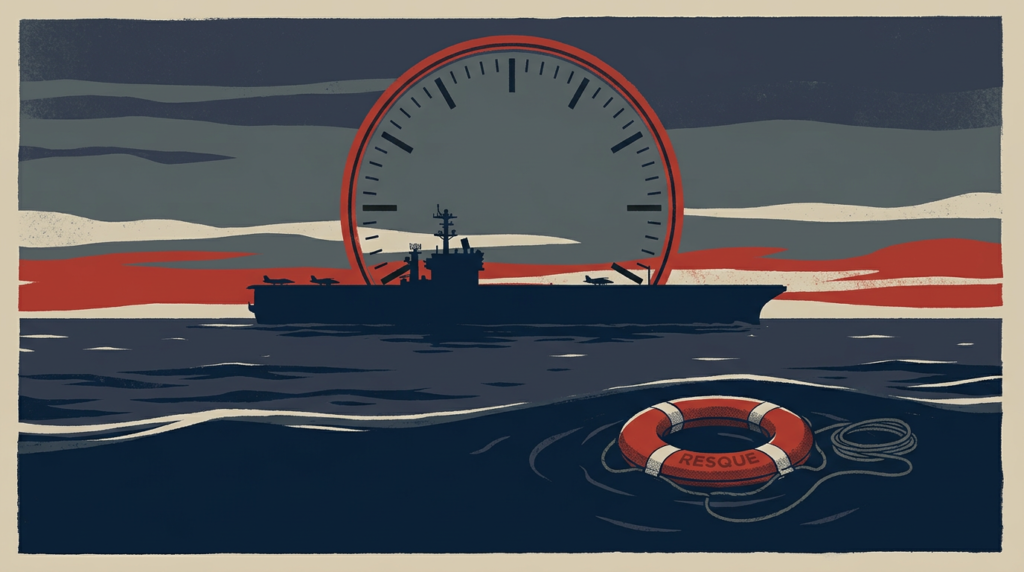
We’ve documented this story across two prior pieces: the USS Abraham Lincoln’s food shortages, moldy showers, broken toilets, and a formal Senate oversight letter demanding answers. Today, for the first time, Trump himself addressed it directly. His answer wasn’t reassurance. It was dismissal, followed by an escalation nobody expected.
WHAT HE ACTUALLY SAID
Speaking to reporters at Joint Base Andrews before boarding Air Force One, Trump was asked directly whether families of USS Lincoln service members had raised concerns about conditions aboard the ship. “No, they’re not,” he said — flatly denying reporting from NBC News and other outlets built on direct interviews with those same families. When a reporter pressed on whether the deployment, now past 265 days against an original seven-month schedule, had gone on too long, Trump’s answer was unambiguous: “No, no, no. Not nearly long enough.”
He offered no acknowledgment of the specific, documented concerns already in the public record: food shortages severe enough that one sailor described a dinner of half a cup of rice and two tortillas, moldy showers with no hot water, and — the detail that should stop this conversation cold — multiple sailors having reportedly attempted to jump overboard during this deployment. Instead, his full comment was: “We make sure that every ship, every crew, every captain has everything we can provide them at every single moment. Some deployments are longer than others, and I have more respect and gratitude for those sailors than anybody.”
THE GAP BETWEEN THE WORDS AND THE FACTS
“I have more respect and gratitude for those sailors than anybody” is a striking thing to say in the same breath as denying documented reports that those same sailors have attempted suicide by jumping into open ocean during a deployment that’s now the longest in the modern Navy’s post-Vietnam history, aside from the Lincoln’s own prior 295-day record set in 2019-2020. Respect and gratitude, as concepts, don’t require denying the specific, sourced concerns families have raised through multiple independent news outlets over the past several weeks. Saying the deployment hasn’t been “nearly long enough” isn’t a policy position about strategic necessity — it’s a value judgment about the acceptable length of human strain, delivered by the one person whose decisions actually control that timeline.
THIS FOLLOWS HEGSETH’S OWN NEARLY IDENTICAL LANGUAGE
Trump’s dismissal echoes, almost word for word, what Hegseth told reporters in Panama the same week: reports about conditions aboard the Lincoln had been “completely misrepresented,” and “we make sure every ship, every crew, every captain has everything we can provide them at every single moment.” That’s not a coincidence of phrasing — it’s the administration’s consistent, coordinated answer to this story regardless of who’s asked: deny the specifics, praise the sailors in the abstract, move on. This is the second time Hegseth personally has dismissed these reports, having already called nearly identical concerns “FAKE NEWS” back in April.
THE RELIEF SHIP IS COMING — BUT NOT SOON
Trump did confirm the Lincoln is being relieved by the USS George Washington, which recently left Vietnam and is now crossing toward the Middle East. But the timeline undercuts any sense of urgency: it will likely take at least two more weeks just for the Lincoln to make its way back to San Diego once relieved, and the replacement process itself could take several weeks to complete. Sailors who have already spent 265 days at sea, on record eating half-cup rice dinners and reportedly attempting to jump overboard, are being told relief is coming — eventually, on a timeline measured in additional weeks, not days.
CONGRESS IS STILL WAITING FOR ANSWERS
None of this addresses the specific, formal questions Sen. Richard Blumenthal posed in his oversight letter to Hegseth and acting Navy Secretary Hung Cao earlier this week: who authorized each deployment extension, what metrics the Navy uses to track crew mental health and fatigue, and whether commanders have seen a rise in safety incidents tied to the deployment’s length. Blumenthal’s letter specifically flagged that “recent carrier deployments have repeatedly stretched beyond their original anticipated durations, suggesting that extended deployments may be becoming a feature rather than an exception of the Navy’s force-generation model” — a structural warning that Trump’s “not nearly long enough” comment today does nothing to address and, if anything, actively confirms.
WHY THIS MATTERS
This is the same war this newsletter has already documented the Pentagon quietly deleting casualties from, and the same administration that’s gone months without holding a single formal Pentagon press briefing. Now add a president who, when directly asked about sailors reportedly attempting suicide during a record-length deployment, responds by denying the reports exist and arguing the deployment should have been longer. That’s not a communications misstep. It’s a stated value judgment from the commander-in-chief about what sacrifice is acceptable to extract from the people serving under him, delivered on camera, with no apparent awareness that it needed softening.