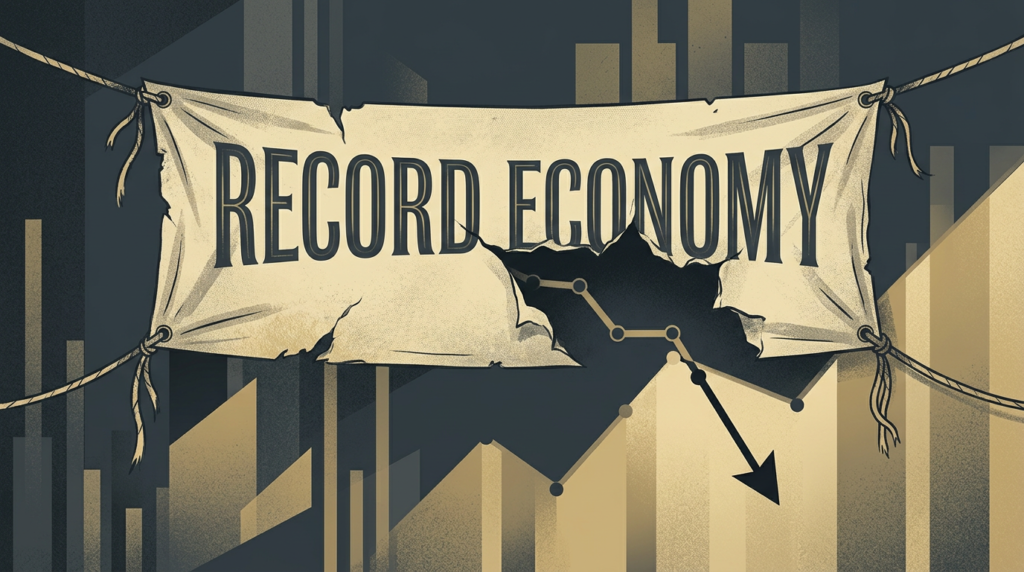
That’s Trump, in his own words, at a June roundtable in Chippewa Falls, Wisconsin, claiming “African American unemployment is now doing better than it’s ever done” — then, in the same breath, admitting he had no idea where the number came from. It’s a rare moment of a president catching himself mid-fabrication and deciding to say it out loud anyway rather than stop. CNN called it what it was: a “mystery stat” that simply isn’t true.
THE ACTUAL NUMBERS
The real Black unemployment rate, per the Bureau of Labor Statistics, was 6.6% as of the most recent data — while the national rate sits at 4.2%. That’s not a minor gap. It’s a full two-and-a-half-point spread between how Black workers and the country as a whole are actually faring, at the exact moment Trump was telling an audience the opposite was true.
The Chicago Crusader’s reporting adds real institutional weight to the “recession” framing, not just individual outlets’ characterization: the National Urban League, the Economic Policy Institute, and the Joint Center for Political and Economic Studies — three separate research organizations — independently reached the same conclusion. As the Joint Center’s own Chief of Staff, Monica Mitchell, put it directly: policy rollbacks removing protections and investments for Black communities have produced “economic indicators, particularly unemployment, that would qualify as recessionary if they were applied to the national economy.” That’s the precise, technical basis for calling this a Black recession — not rhetorical flourish, but an actual application of standard recession criteria to data that already meets the threshold within one demographic group.
THE SCALE OF THE JOB LOSSES
Columnist Antjuan Seawright’s analysis lays out numbers that should be a national story on their own: Trump’s rollback of DEI policies cost 300,000 Black women their jobs in a single three-month span last year, and more than half a million Black men lost jobs between November and February. As of this month, roughly 600,000 Black women remain out of work. Seawright’s framing of the vulnerability gap matters too: 59% of Black Americans lack the savings to survive a layoff, compared to 40% of white Americans — meaning the same job loss lands with meaningfully more severe consequences depending on who’s experiencing it, on top of an already worse starting unemployment rate.
THE BROADER ECONOMIC PICTURE UNDERCUTS THE “GREATEST ECONOMY” CLAIM TOO — NOT JUST THE BLACK-SPECIFIC NUMBERS
This isn’t a story where the overall economy is genuinely strong and only one community is being left out. FactCheck.org’s own nonpartisan analysis found job growth between January 2025 and January 2026 — Trump’s own first full year back in office — totaled just 359,000 jobs, a 0.2% gain. Compare that to Biden’s final year in office: 1.2 million jobs added, a 0.8% gain — more than three times the growth rate. Trump has also repeatedly claimed he “inherited the worst inflation in the history of our country” and now has “almost no inflation” — but FactCheck notes inflation was already at 3% when he took office, nowhere close to historic-worst territory, undercutting both the premise and the claimed fix.
A separate national address drew the same pattern into even sharper relief: Trump told the country “I am bringing those high prices down and bringing them down very fast,” while the Department of Labor’s own data showed inflation sitting at essentially the same rate as when he entered office. He claimed “wages are going up much faster than inflation” and that “inflation is stopped” — both contradicted by the government’s own numbers. The overall U.S. unemployment rate in that same period had climbed to its highest point since the 2021 pandemic recovery, at 4.6% — with Black Americans at 8.3% and young workers at 10.6%, both dramatically worse than the topline number Trump was citing as evidence of success.
WHY THIS PATTERN MATTERS
This is the same dynamic already documented in this newsletter’s jobs report coverage: an administration that responds to unfavorable economic data not by addressing it, but by disputing the data itself, replacing the officials who report it, or — as this case shows — simply inventing a better-sounding number and admitting on camera that its source is unknown. The gap here isn’t a matter of interpretation or which economic indicator you weight most heavily. It’s the president’s own stated numbers versus the Bureau of Labor Statistics’ actual published numbers, on the record, with three independent research organizations converging on the same “recession” framing specifically because the data already meets that technical bar for Black workers, even while the national topline gets described as historic success.