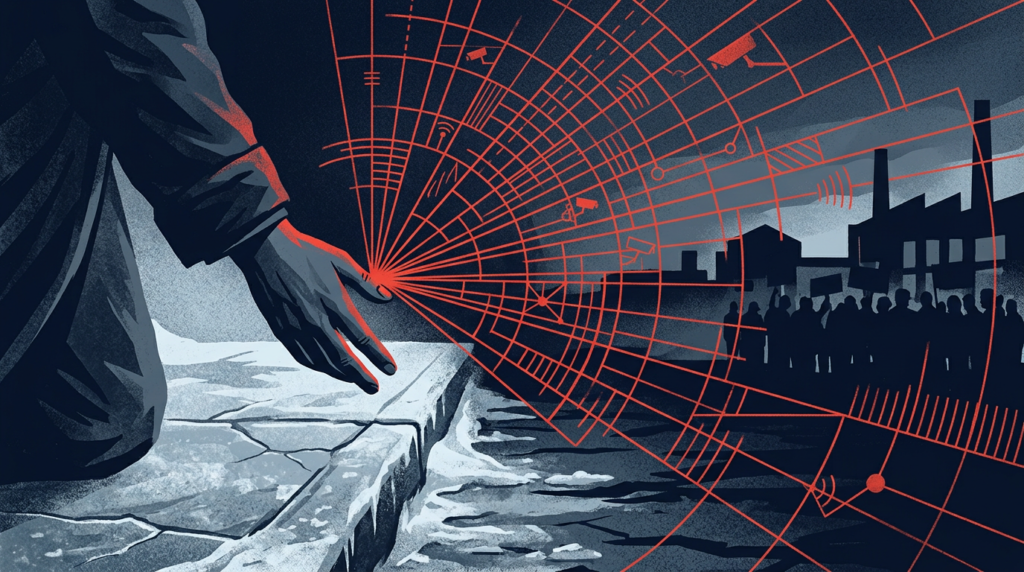
Alex Pretti was a 37-year-old ICU nurse at a VA medical center. On January 24, he was filming federal agents interacting with two civilians on a Minneapolis street when one of the agents pepper-sprayed the group and shoved a woman, who slipped on ice and fell. Pretti — his phone still in his right hand — moved to help her up. Bystander video shows what happened next: agents pepper-sprayed him again as he turned to assist her, then seven agents surrounded him and wrestled him to his knees. He was shot at least ten times. His legally licensed handgun never left its holster. His last words, to the woman he’d stopped to help, were: “Are you OK?”
THE GOVERNMENT’S FIRST INSTINCT: CALL HIM A TERRORIST
The administration’s immediate public response wasn’t to investigate its own agents’ conduct. It was to accuse Pretti of being an armed “domestic terrorist” who “wanted to do maximum damage and massacre law enforcement.” Multiple independent bystander videos directly contradicted every part of that characterization. Days later, Trump escalated rather than corrected course, calling Pretti an “agitator and, perhaps, insurrectionist” on social media, citing footage from a separate, prior encounter — footage his own family’s attorney noted couldn’t possibly justify what happened on January 24 regardless of what it showed.
WHERE THE ACTUAL INVESTIGATION WENT — AND WHERE IT DIDN’T
Here’s the part that should be the real headline. Four days after Pretti’s death, the Department of Homeland Security’s St. Paul office quietly opened an investigation. Not into Jesus Ochoa and Raymundo Gutierrez, the two Border Patrol and CBP agents who fired the shots — both placed on paid administrative leave, both eventually identified only through independent ProPublica reporting, not any voluntary government disclosure. The investigation targeted, instead, a list of left-leaning political organizations: the Sunrise Movement, the AFL-CIO, SEIU, the Democratic Socialists of America, and a collective called Direct Action Minnesota — examining whether these groups had provided “help and money” to people who’d participated in the broader protest movement against the immigration crackdown.
The New York Times’ reporting, published Wednesday, is direct about the scope: the government conducted expansive surveillance, infiltrated group chats, and obtained financial records of organizations that have never been accused of any crime. A court filing in a related case — the “Minnesota Antifa 15” prosecution — reveals even more disturbing detail, first reported by national security journalist Marcy Wheeler: the DOJ prosecutor placed in charge of investigating “Antifa” is someone who himself entered restricted Capitol grounds on January 6, and he presented grand jury material attempting to tie much of the broader Minnesota left, and reportedly activists nationally, to the alleged conduct of one small group. The same filing describes a Clearview facial-recognition dossier run on a defendant that produced a false-positive match implicating an entirely unrelated man, his pregnant wife, and their young child.
THE PALANTIR CONNECTION
This surveillance apparatus didn’t emerge from nothing. DHS finalized a $1 billion no-bid contract with Palantir shortly after Pretti’s killing — the same kind of data-analytics infrastructure that makes exactly this style of networked investigation, tying labor unions and climate groups to a protest movement through financial records and chat infiltration, dramatically easier to execute at scale.
MEANWHILE: THE ACTUAL SHOOTING INVESTIGATION HAS GONE NOWHERE
NPR’s reporting from April — months after the killing — found the federal investigation into Pretti’s death remained, in the outlet’s own words, “elusive.” DHS told NPR the Justice Department was leading it. The DOJ didn’t respond to NPR’s request for comment at all. The pattern repeats across all three Minneapolis-area shootings from this same immigration surge: Julio Cesar Sosa-Celis, shot and wounded, still under an unresolved “internal investigation”; Renee Macklin Good, killed by ICE officer Jonathan Ross, with DHS’s only public statement being that “the matter remains under investigation,” full stop, no further detail. ProPublica and PBS Frontline’s joint investigation, published in April, documented a related pattern: arrests at anti-ICE protests piled up rapidly, while the prosecutions built on those arrests kept crumbling in court.
THE THROUGH-LINE
A man died trying to help a stranger off an icy sidewalk. The government’s first move was to call him a terrorist, contradicted by video within days. Its actual investigative energy, once the terrorist framing collapsed, went not toward the two agents who fired ten shots at an unarmed man, but toward mapping the financial and organizational ties of labor unions, a climate group, and a socialist collective — none of them accused of any crime — using a billion-dollar surveillance contract signed in the killing’s immediate aftermath. Sen. Chris Van Hollen’s formal complaint this week is the first real institutional pushback this has drawn. Months later, the actual shooting investigation remains, by the government’s own non-response, nowhere at all.