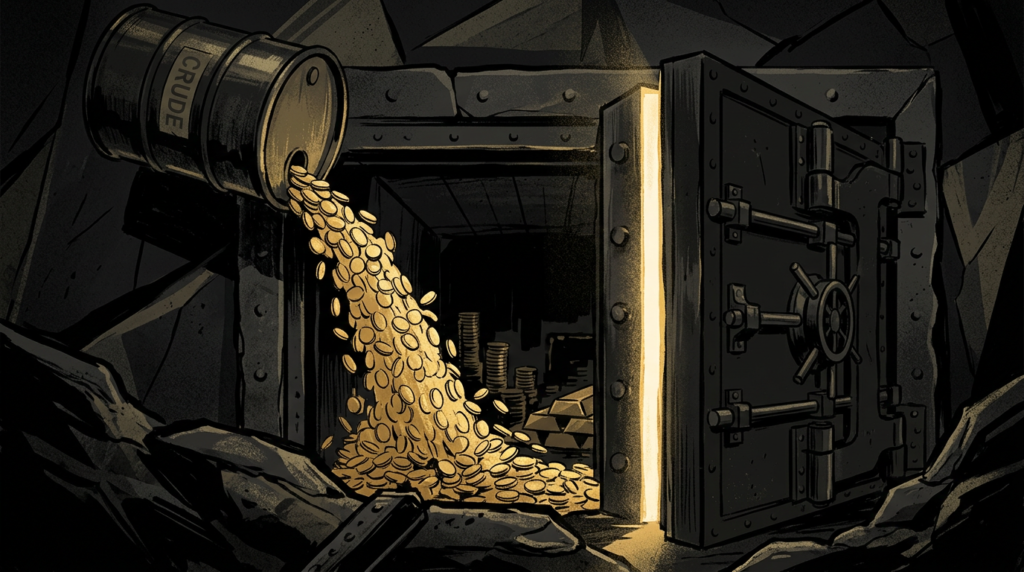
We first covered this story when the figure sat at $13 billion collected with no public breakdown. It’s gotten sharper and more damning since — a precise gap has now been documented between what’s been collected and what anyone can actually trace, and a growing bipartisan chorus in Congress is demanding an independent audit the administration keeps declining to fully provide.
THE NUMBERS, PRECISELY
Following the January capture of Nicolás Maduro, the U.S. assumed direct oversight of Venezuela’s oil export proceeds under Executive Order 14373. A Financial Times investigation, corroborated by multiple outlets since, found the arrangement has generated roughly $13 billion in revenue. Of that, only about $300 million has been publicly traced back to actually reaching Venezuela. That’s not a rounding gap — it’s roughly 2% of the total collected revenue with any public accounting at all.
Secretary of State Rubio confirmed under sworn Senate testimony in late January that the first sale — $500 million — was deposited into a Qatari bank account owned by Venezuela but controlled by the U.S. He described the entire arrangement as “novel” and “a short-term mechanism,” justified because the U.S. doesn’t recognize the current government in Caracas and because funds held directly in U.S. institutions could be vulnerable to claims from Venezuela’s creditors. He also acknowledged, on the record, that a formal audit process hadn’t been finalized at the time — meaning the mechanism was operating for months before any real verification structure existed.
THE ACCOUNTING KEEPS GETTING MURKIER, NOT CLEARER
A State Department witness told Congress in April that roughly $3 billion had been authorized for disbursement to Venezuela — but couldn’t say how much money actually remained in the Treasury accounts holding the rest. Congressional oversight committees report they’ve received no documentation at all since April, a four-month information gap during a period when the collected total nearly doubled. Treasury Secretary Scott Bessent told the House Financial Services Committee in February that no formal audit agreement was even in place at that point, though his agency planned to eventually engage outside auditors. State Department officials now claim billions have entered the Venezuelan economy under KPMG audit supervision — but that claim hasn’t been matched with documentation Congress can independently verify, and it directly conflicts with lawmakers’ own account of a documentation blackout since spring.
Senior State Department official Michael Kozak’s own characterization of the arrangement, given directly in congressional testimony, captures the entire power dynamic in one line: “It’s their money but… they have to get our permission.” A CFR analysis by Roxanna Vigil, a former senior Treasury sanctions policy adviser, put the scale in more concrete terms: almost 100 million barrels, worth an estimated $8 billion, had moved through a process she described as marked by “no transparency and minimal oversight” — with the administration disclosing neither how much oil it had sold, how much revenue it had collected, nor how the funds had actually been used.
CONGRESS IS NOW ESCALATING ON MULTIPLE FRONTS
This has moved well past a single letter. House Oversight Ranking Member Robert Garcia has now formally escalated his investigation as the total crossed $13 billion, stating plainly: “If this Administration has nothing to hide, it should immediately provide the transparency and answers the American people deserve.” Garcia’s committee separately flagged Trump’s own recent public suggestion that these funds have paid for the U.S. intervention in Venezuela “many times over” — a claim offered with no evidence, alongside the sobering fact that Venezuela itself is simultaneously facing roughly 5,000 deaths and nearly $20 billion in costs from catastrophic earthquakes, with no documented material benefit from this oil revenue reaching that crisis.
In the Senate, Van Hollen, Kaine, Castro, and Casten have formally requested a GAO audit covering the full history of the arrangement — both the initial period when funds were routed through Qatari accounts and the current Treasury-controlled structure — specifically demanding a full accounting of every agency, employee, and contractor involved, and identification of which financial executives stand to personally benefit. Separately, Sens. Schiff and Schumer introduced the Venezuela Oil Proceeds Transparency Act, which would legally require a GAO audit. As of the most recent reporting, that bill has attracted no Republican co-sponsors — but the GAO has reportedly opened its own review independently anyway, giving this the first genuine, executive-branch-independent oversight the arrangement has faced since it began.
THE PART THAT SHOULD BOTHER PEOPLE ACROSS PARTY LINES
Rep. Joaquin Castro’s framing lands the sharpest, most direct version of the underlying concern: “Trump’s invasion of Venezuela has been about oil, power and graft from the very beginning, with billions of dollars in Venezuelan oil revenue being controlled by the Trump administration without transparency or safeguards.” Set that against Trump’s own public statements — celebrating that Venezuela is now a “strategic ally,” praising interim leader Delcy Rodríguez, a holdover from the same Chavista power structure Rubio himself once called “corrupt and broken,” for doing a “great job.” Rubio’s own January assessment of the Venezuelan oil sector’s core problem — endemic corruption and graft — is now describing an arrangement where the U.S. controls the money, discloses almost none of it, and the same entrenched ruling elite Rubio criticized remains in power regardless.
This is the same broader pattern already documented throughout this newsletter: an administration consistently choosing to control the money and control the information about the money, simultaneously, whether the subject is a $27 billion domestic equity stake portfolio, an $800 million corporate shakedown operation, or — here — $13 billion in a foreign nation’s oil wealth, 98% of which has no public paper trail at all.