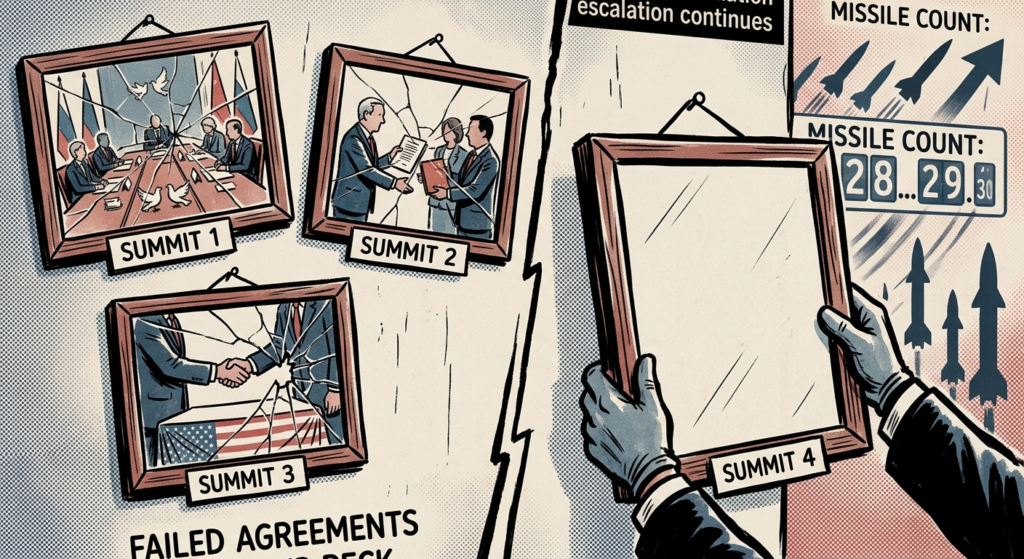
Trump confirmed today that he intends to meet Kim Jong Un again this year — possibly as soon as this fall, with aides reportedly eyeing a sit-down during his November trip to Asia. “Yeah, I will,” he told reporters, adding, “I get along with him. And you know what? The fact that I get along with him — that’s a good thing.” This would be summit number four. Let’s talk about what happened after summits one through three.
Trump met Kim three times in his first term — Singapore, Vietnam, and the DMZ in 2019, where he became the first sitting U.S. president to set foot in North Korea. Those meetings produced photographs, a pledge from Kim to “denuclearize,” and love letters Trump bragged about at a West Virginia rally: “We fell in love.” What they did not produce was denuclearization. North Korea walked away from the table, rejected further formal talks with Washington, and then — while Trump was out of office and since — dramatically accelerated its nuclear weapons program. Independent experts now estimate its arsenal at several hundred warheads, an order of magnitude beyond the low estimates still casually cited in public debate. North Korea has also locked in a new military alliance with Russia, sending troops to fight in Ukraine and gaining real battlefield experience in the process, and deepened missile cooperation with Iran. This is the position North Korea is negotiating from now: stronger, better armed, and battle-tested, specifically because the last round of personal diplomacy bought it years of uninterrupted buildup with no consequences attached.
And what number does Trump himself use to describe that arsenal? “He has 57 very powerful nuclear weapons,” Trump told reporters this week. Nobody, including NBC News reaching out directly to the White House, can explain where he got that figure. It’s not close to the independent estimates. Either the president doesn’t know how large the threat actually is, or he’s saying a smaller number out loud because it makes “I get along with him” sound like a foreign policy strategy instead of what it actually is: a personal fondness substituting for verification.
This didn’t happen in a vacuum, either. One day before Trump confirmed he wants this meeting, he ordered the Pentagon to scale back joint military exercises with South Korea — a treaty ally — citing, in his own words, his “very good relationship” with Kim. So the sequence is: soften the alliance commitment first, on the basis of the friendship, then use the softened posture to go looking for the meeting the friendship was supposedly already justifying. That’s not diplomacy building momentum. That’s a rationale being built backward to fit a decision Trump had already made.
There’s also a more cynical read available, and it’s not just ours — foreign policy analysts have pointed out that Trump’s renewed push for a Kim summit lines up suspiciously well with his lack of any deliverable success in the ongoing Iran war. A splashy fourth meeting with Kim is exactly the kind of image that can paper over a stalled war with no peace deal and gas prices Americans are being told to just accept. It’s a distraction dressed up as a legacy move.
And Trump’s own explanation for why any of this is supposed to work this time is, frankly, unserious: “I know Kim Jong Un very well, and he’s going to be fine as long as we have a smart president. He’s going to be fine. If we have a dumb president, then he’s probably not going to be so fine.” Read that closely. North Korea’s nuclear buildup, its alliance with Russia, its missile-sharing with Iran — none of that gets attributed to Kim’s own choices in that sentence. It all gets filed under whether the American president is smart enough to charm him. That’s not a strategy. That’s a man describing his own ego as a nonproliferation policy.