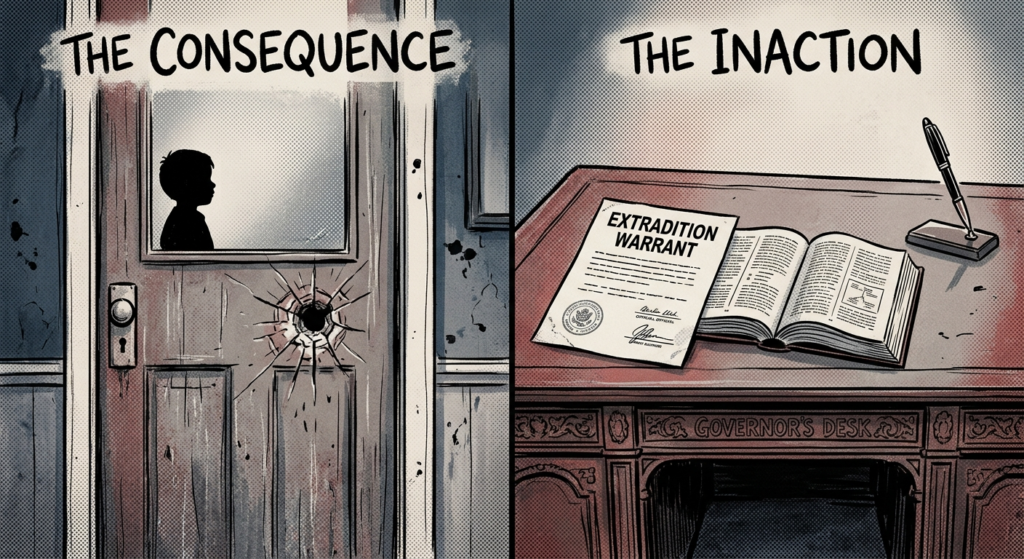
Here’s the sequence, and none of it requires embellishment because the facts alone are damning.
On January 14, 2026, ICE agent Christian Castro fired his weapon through the front door of an occupied home in Minneapolis during Operation Metro Surge — the same immigration enforcement operation that, one week earlier, had already left U.S. citizen Renee Good dead at the hands of another ICE agent, and would later claim the life of Alex Pretti too. Castro’s bullet hit Julio Cesar Sosa-Celis, a Venezuelan man, in the leg. Another bullet lodged in a child’s bedroom wall. Castro then, according to Minneapolis prosecutors, lied about what happened. A Hennepin County judge found probable cause on both counts — the shooting and the lie — and Castro was charged with four counts of second-degree assault with a deadly weapon plus falsely reporting a crime. A judge issued a nationwide warrant for his arrest.
Texas Rangers picked him up on May 29. And that’s where accountability stopped, because Texas Governor Greg Abbott has spent every day since deciding that a man facing four felony charges for shooting through a family’s front door with a child in the house doesn’t need to answer for it — not if the badge says ICE.
Minnesota Governor Tim Walz requested extradition four days after the arrest. That was June 2. Abbott sat on it. Not a denial, not a legal objection, not a single stated reason — just silence and a signature he refused to provide, month after month, while Castro sat in a Cameron County jail a few miles from the border he could walk toward the second Texas law forces his release. Because that’s the trapdoor here: Texas can only hold him 90 days without an extradition order. That window closes any day now. Abbott knows it. He’s let the clock run anyway.
So on Tuesday, Minnesota Attorney General Keith Ellison did what governors who take the Constitution seriously shouldn’t have to do to each other: he sued. In federal court. To force a sitting governor to comply with the extradition clause.
And here’s why Ellison’s case isn’t a close call — why this isn’t a debate about states’ rights or federalism at all. In 1987, the Supreme Court decided exactly this question, unanimously, in Puerto Rico v. Branstad. Justice Thurgood Marshall wrote for the Court that a governor’s role in extradition is a “ministerial duty” — meaning the governor doesn’t get to weigh the evidence, doesn’t get to have policy views about the case, doesn’t get to decide the charges seem unfair or the defendant seems sympathetic. The governor’s job, once the demanding state’s paperwork checks out — proper indictment, correct identity, presence in the state at the time of the offense — is to sign the warrant. Full stop. That’s it. That’s the entire discretion the Constitution allows.
Branstad overturned an 1861 Civil War-era case, Kentucky v. Dennison, which had said federal courts couldn’t force a governor to comply even though the Constitution required it — a rule so toothless it let states simply ignore extradition demands with no consequence for over a century. The Supreme Court killed that loophole. Unanimously. Marshall’s opinion is blunt about why: allowing governors case-by-case discretion over which fugitives to hand over “would place every State” outside the reach of the Constitution’s plain text, and long practice that conflicts with the Constitution “cannot overcome this Court’s responsibility to enforce” it.
Texas has stipulated, in past cases just like this one, when its own extradition paperwork was in order. Nobody is claiming Minnesota’s warrant against Castro is defective. Nobody is disputing Castro is who Minnesota says he is, or that he was in Minneapolis when the shooting happened. Abbott isn’t raising a legal defect. He’s just refusing — the exact non-discretionary discretion Branstad said doesn’t exist. When Ellison told reporters “Christian Castro is not above the law, and Greg Abbott isn’t, either,” he wasn’t making a political point. He was citing the actual holding of a unanimous 1987 Supreme Court decision.
And when reporters asked Abbott to explain the refusal directly, he didn’t answer. He changed the subject to an unrelated claim about Minnesota welfare fraud. That’s not a legal defense, because there isn’t one available to him. It’s what a governor says when the law has already decided the question and he doesn’t like the answer.