Then Sold Them Into a Slaughter Pipeline for Pocket Change
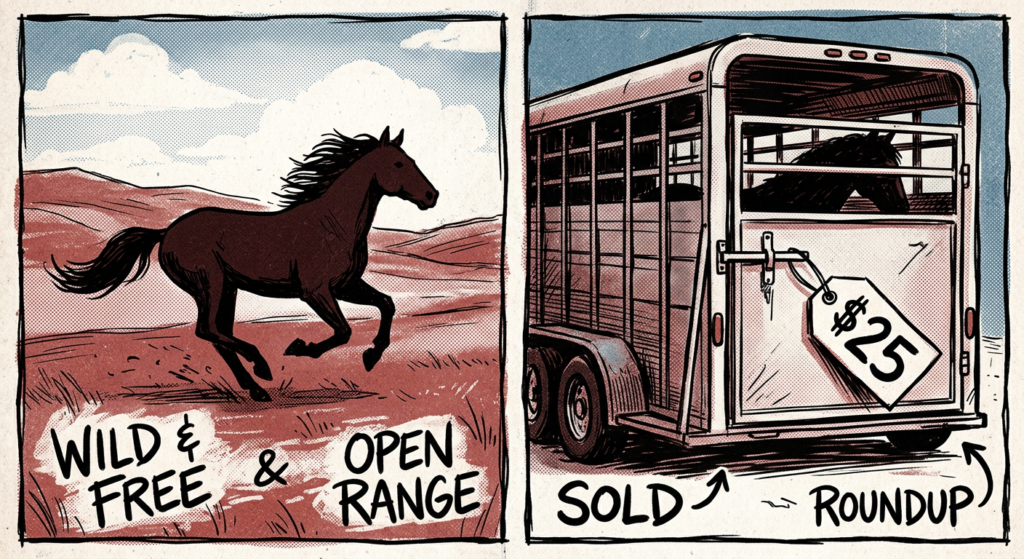
Here’s the arithmetic first, because the arithmetic alone should be disqualifying. The federal government spends roughly $3,000 to helicopter-round-up a single wild mustang off public land. It then sells that same horse — protected by federal law since 1971 — for as little as $25. The buyer, in turn, can flip that horse to a slaughter plant abroad for up to $750. Somewhere in that chain, the government is losing nearly $3,000 a head on animals it’s legally supposed to be protecting, while a middleman walks away with a markup north of 2,900%. That’s not a management program. That’s a laundering operation with a government logo on it.
The New York Times just documented exactly how it works. This March, a batch of wild horses got trucked 1,800 miles from western rangeland to the pens of a livestock trader in Ohio named Brandon Jones, who bought them for $25 each. A day later — not a week, not a month, a day — two double-decker cattle trucks pulled up at midnight and hauled them away. Horse slaughter is illegal on U.S. soil. It is not illegal in Canada or Mexico, where horse meat gets processed and exported. The BLM’s own Sale Authority program creates the loophole: sell cheap to a private buyer, get a signed certification promising the horse won’t go to slaughter, and then look away while more than 3,700 horses move through exactly that pipeline. The certifications aren’t worth the paper they’re printed on unless somebody actually prosecutes the buyers who violate them — lying on a federal form like that is a felony, up to five years. The BLM has the signed forms sitting in a file. Nobody’s using them.
And this isn’t incidental drift in a bureaucracy nobody’s watching. Trump’s own FY2026 budget request specifically proposed striking the congressional safeguard that has, for years, explicitly barred the BLM from selling or transferring protected wild horses to anyone who might send them to slaughter. Same budget: a 25% cut to the wild horse and burro program, down to $106 million, with no real plan for the more than 64,000 animals already sitting in government holding pens — pens that cost $100 million a year to run, and for which the BLM has floated buying a gas chamber to kill the backlog outright, an idea Congress has so far refused to fund.
Attorney General Pam Bondi, meanwhile, spent this spring loudly announcing a crackdown on government-funded animal cruelty — dogs, research animals, the sympathetic cases that make for a clean press release. Not one word about the federal agency in her own administration running horses through a $25 revolving door to slaughterhouses on two other continents. That’s not an oversight. That’s a choice about which cruelty is worth a press conference and which one gets buried in FOIA records a sanctuary group had to go dig up itself.
To be fair to the historical record: this loophole didn’t start with Trump. The 1971 Wild Free-Roaming Horse and Burro Act has always allowed sale of older, “unadoptable” animals, and administrations going back to George W. Bush wrestled with the same budget math and the same livestock-lobby pressure to thin the herds. What’s different now isn’t the existence of the loophole — it’s an administration actively trying to widen it in its own budget request, while its Justice Department runs a parallel PR campaign about caring for animals that carefully avoids mentioning this one.
You can capture a horse for $3,000 and sell it for $25, or you can actually manage the program you’re constitutionally responsible for. This administration chose the version that loses money on paper and horses in real life, and called it fiscal restraint.