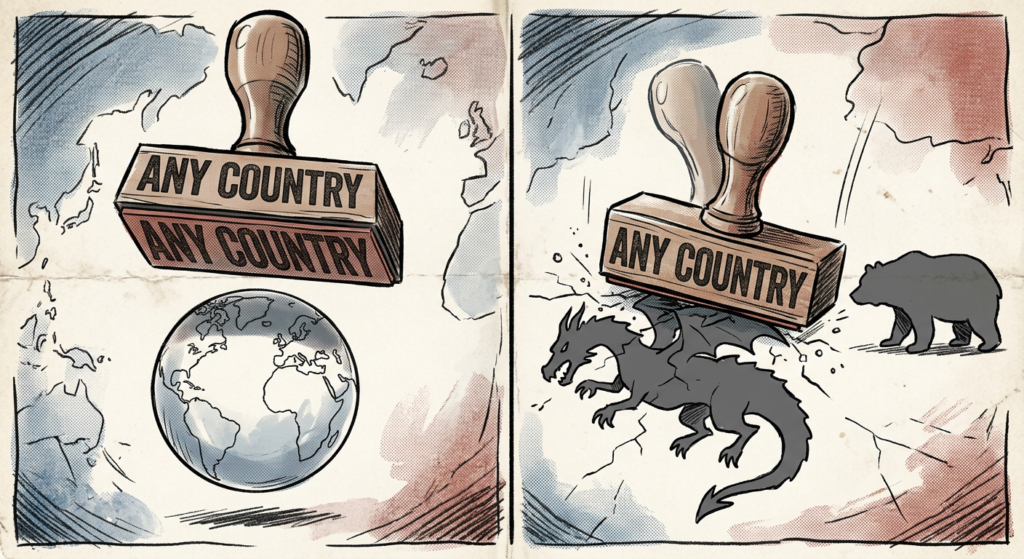
Trump announced Wednesday that Iran is about to face “Economic Warfare and Isolation on an unprecedented scale” — an “ECONOMIC D-DAY,” his words, all caps. The threat: any country that lets its financial institutions, businesses, airports, or government entities give Iran “any type of lifeline” — oil purchases, cash transfers, currency swaps, ship registries, front companies — will face “TREMENDOUS Economic Consequences.” Treasury Secretary Scott Bessent is set to detail the specific measures at a press conference Monday. Oil prices have already climbed for five straight days just on the threat.
Notice what’s missing from the announcement: names. Trump didn’t identify a single country. Analysts filled in the blank immediately, and correctly — the obvious target is China, which buys the overwhelming majority of Iran’s oil exports and has for years. That’s a real, defensible policy lever if enforced. But “any country” is doing a lot of work in that sentence, and the honest question is whether it actually includes the country that’s done more than any other to keep Iran’s war effort running: Russia.
Because Russia isn’t a bystander here. It’s been Iran’s most consequential material partner throughout this conflict — deepening missile cooperation, sharing drone technology (the same Shahed drones Iran has supplied Russia for its own war in Ukraine flow both ways), and standing as Tehran’s clearest geopolitical backer against Washington. If “economic D-Day” is genuinely about punishing anyone propping up Iran’s war-fighting capacity, Russia isn’t a marginal case. It’s close to the center of the target.
Except Trump already made his call on Russia this year, and it wasn’t isolation — it was relief. Back in April, his administration eased oil sanctions on both Iran and Russia in the same policy move, a decision foreign policy analysts flagged at the time as a gamble that risked undercutting the entire pressure campaign it now claims to be relaunching. You cannot credibly threaten “tremendous economic consequences” for nations helping Iran while, months earlier, loosening the exact sanctions regime meant to isolate Russia — Iran’s most militarily useful partner in this war.
This is the same shape you’ve seen in every other move this administration has made this year: soften on the nuclear-armed or geopolitically favored country, escalate rhetoric against the one that’s diplomatically convenient to target. Reduce military exercises with South Korea over “friendship” with a nuclear-armed Kim Jong Un, then threaten to bomb Oman, a mediating ally with no nuclear program at all. Ease sanctions on Russia’s oil trade, then announce an unnamed, sweeping “D-Day” that conveniently points reporters toward China instead.
Iran’s foreign minister, for what it’s worth, called the whole announcement a distraction from America’s own economic troubles — unprecedented debt, rising costs — and while that’s obviously a self-interested response from the country on the receiving end, it’s not hard to see where the framing lands: sweeping, undefined threats aimed at “any country,” delivered by all-caps social media post, without a single named target, one negotiating session away from being quietly walked back once the actual costs to friendly economies come due.
If Monday’s Treasury announcement doesn’t include real, enforceable measures against Russian entities that have supplied Iran’s war machine, then “any country” was never the policy. It was the headline.