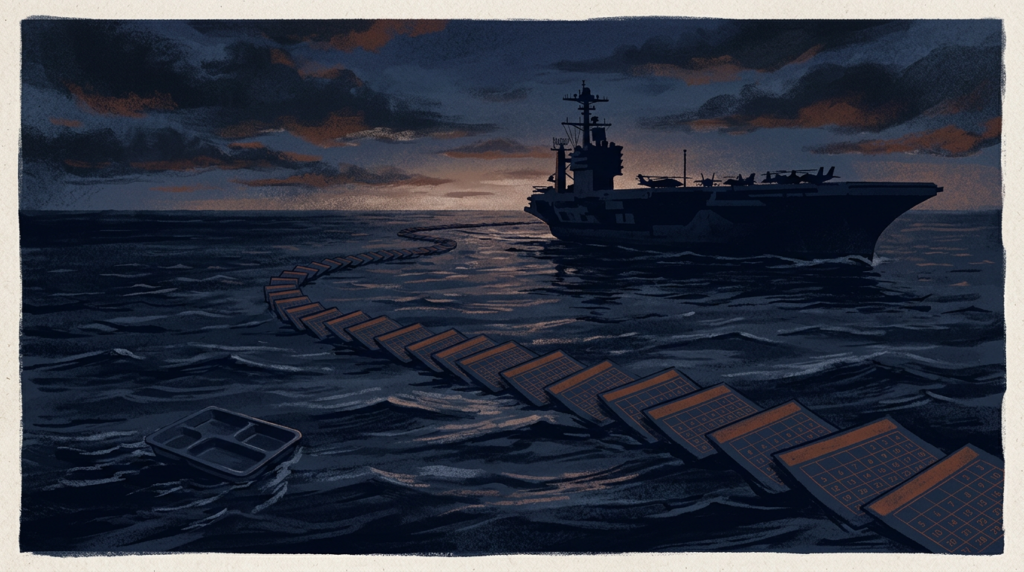
The USS Abraham Lincoln left Naval Base San Diego on November 21, 2025, for what was supposed to be a seven-month deployment. As of this writing, it’s been more than 250 days at sea — a record for consecutive days without a port call — supporting combat operations against Iran that Congress never formally authorized. Roughly 5,000 sailors and Marines remain aboard.
WHAT THE FAMILIES ARE SAYING
MS NOW spoke with a dozen family members whose accounts, corroborated across multiple outlets, paint a consistent picture: food shortages, moldy showers with no hot water for extended stretches, broken toilets, laundry facilities down for weeks at a time, and shortages of basic hygiene supplies — soap, toothpaste, deodorant. Nicole Conrad, whose son serves aboard the Lincoln, told reporters he described a meal that consisted of half a cup of rice and two tortillas. She hasn’t seen her son’s face in seven months. Her message, directed straight at Defense Secretary Hegseth: “Go visit. If you want to sit here and you want to say that Trump is taking care of the soldiers, go yourself.”
This isn’t a new story that appeared out of nowhere — it’s the second time this year an aircraft carrier on extended deployment has drawn these exact reports, following similar coverage of the USS Gerald R. Ford strike group, which a separate March 2026 congressional letter flagged as approaching its own tenth month at sea and warned could exceed the prior deployment-length record the Lincoln itself set back in 2020. In April, USA Today published photographs of meals served aboard the Lincoln and USS Tripoli — half-empty trays, small portions, gray processed meat — that prompted several members of Congress to call for investigations.
THE PENTAGON’S RESPONSE, THEN AND NOW
Back in April, Hegseth personally dismissed the food-shortage reports as “fake news” on social media. This month, when the same complaints resurfaced with far more detail and far more family voices attached, the Navy’s response was more careful but still minimizing: 5th Fleet spokesman Cmdr. Joseph Hontz acknowledged the crew has “occasionally run low on certain supplies for brief time periods,” attributing it to the deployment’s length combined with regional operations and geography, while insisting the crew remains “resilient” and currently has “adequate” supplies.
Worth being precise and fair here, since accuracy matters: independent fact-checkers, including Snopes, note the full scope of these specific reports remains under active investigation as of this writing, and the Navy disputes the severity characterization even while acknowledging the underlying shortages occurred. This isn’t a story where every detail has been independently verified beyond the families’ own accounts and the Navy’s partial acknowledgment — but the pattern of “leadership calls it fake news, then quietly admits a version of the same thing months later” is itself well-documented and worth naming directly.
CONGRESS IS NOW FORMALLY DEMANDING ANSWERS
On August 12, Sen. Richard Blumenthal sent a formal oversight letter directly to Hegseth, laying out the timeline in stark terms: the Lincoln has been deployed more than 250 days against an original seven-month schedule, hasn’t made a port call in over 200 days — a new record for consecutive days at sea — and has seen widespread reports of “shortages of basic supplies, water contamination, plumbing issues, deteriorating mental health, deck safety concerns, and disruptions in the mail system,” including care packages lost in transit for months. The letter poses direct, specific oversight questions: who authorized each deployment extension and citing what operational justification; a full accounting of habitability and supply problems and when they were first identified; and what metrics the Navy is actually using to track crew fatigue, morale, mental health, and readiness — including whether commanders have seen any rise in safety incidents, medical issues, or disciplinary problems tied to the deployment’s length.
WHY THIS MATTERS BEYOND ONE SHIP
An aircraft carrier flight deck is already one of the most dangerous workplaces in the entire military — fast-moving aircraft, live ordnance, outdoor conditions in every weather extreme, constant engine noise causing documented hearing loss. Layer onto that 12-to-16-hour shifts with sometimes no days off, a deployment extended not once but twice, malnutrition-adjacent food shortages, and months without basic hygiene supplies, and you have a genuinely serious readiness and safety question — not a comfort complaint. This is the same war we’ve already documented the Pentagon quietly deleting casualties from and refusing to brief the press on for months at a stretch. Now add a flagship carrier crew running on rice-and-tortilla dinners and broken toilets, with leadership’s first instinct being to call the reporting fake rather than fix the supply chain — and the pattern across this entire war becomes the same pattern every time: minimize, deny, and let Congress and the families do the work of dragging the truth into the open.