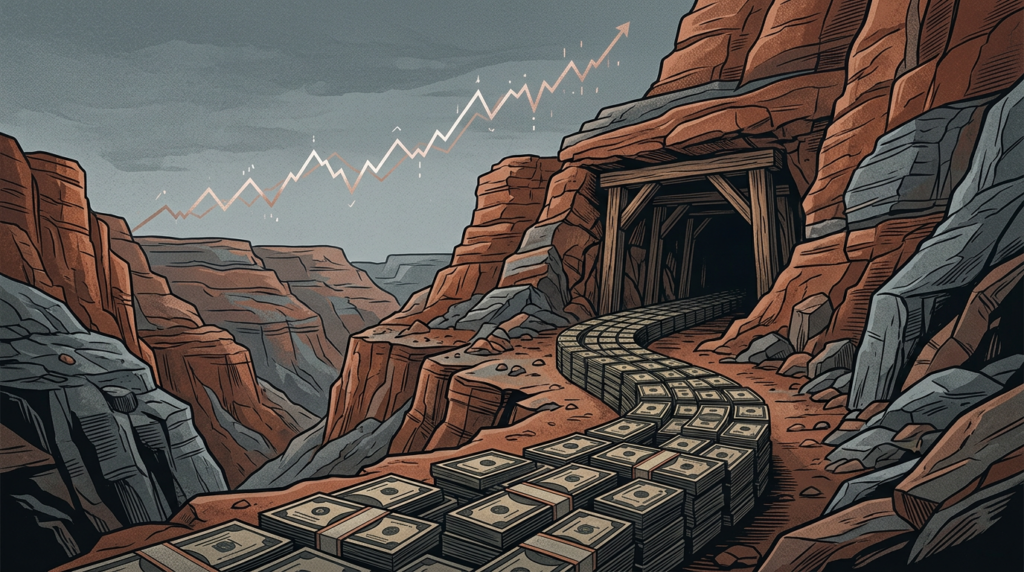
We’ve already documented how Trump’s executive orders shrank Bears Ears and Grand Staircase-Escalante by more than 90%, with the orders themselves explicitly citing the coal and uranium reserves underneath as justification. What we hadn’t yet covered: which specific company was positioned to benefit most, and the federal money and stock trades that flowed to it right before that benefit became public.
THE COMPANY
Energy Fuels Resources owns the Pinyon Plain uranium mine near the Grand Canyon’s South Rim and operates the White Mesa Mill near the Ute Mountain Ute Reservation — the only conventional uranium processing mill left in the entire United States. Inside the original, Obama-designated Bears Ears boundaries, more than 350 uranium and vanadium claims existed — roughly a third of them held by this single company, which also holds the idled Daneros mine right on the monument’s western edge. When Bears Ears was shrunk 85% during Trump’s first term in 2017, the boundary lines drawn specifically excluded the bulk of the region’s uranium deposits — not a coincidence, according to reporting that traces uranium industry lobbying directly to that 2017 decision. This year’s second, even deeper reduction reopens ground Energy Fuels has spent years positioned to access.
THE MONEY
Energy Fuels received a $725 million loan from the U.S. Department of Defense, using part of it to begin expanding the White Mesa Mill — the exact facility that processes uranium from exactly the deposits this year’s monument reductions just reopened. Congressional Democrats are now formally investigating the company for alleged insider trading tied to the timing of that loan and related company stock activity, examining whether people with advance knowledge of the coming land-use change traded or positioned themselves accordingly before the public knew what was coming.
WHY THE TIMING MATTERS
This is the same pattern we’ve documented across nearly every piece in this project: public land use decisions that look, on paper, like national policy about mineral independence or energy security, but that trace back to specific, identifiable private beneficiaries who had money and information moving in their direction before the official decision became public. A $725 million taxpayer-backed loan to expand processing capacity, arriving before the land supplying that mill’s uranium was reopened, is not proof of coordination by itself — but it’s exactly the kind of sequence that triggers a real congressional investigation, which is precisely what’s happening now.
THE BROADER CONTEXT
Worth remembering what’s actually underneath these monument reductions in real economic terms: independent assessments, including Utah’s own Department of Natural Resources, have found “very little energy potential” in significant portions of the reopened land, and Grand Staircase-Escalante’s coal has sat unmined since Trump first opened it during his own first term because it was never considered profitable enough to extract. Uranium is different — it’s the one resource here analysts consistently describe as the “realistic target,” which is exactly why a company already holding a third of the claims inside the original monument boundary, and already the recipient of a nine-figure federal loan, is the company now facing a congressional insider-trading inquiry.