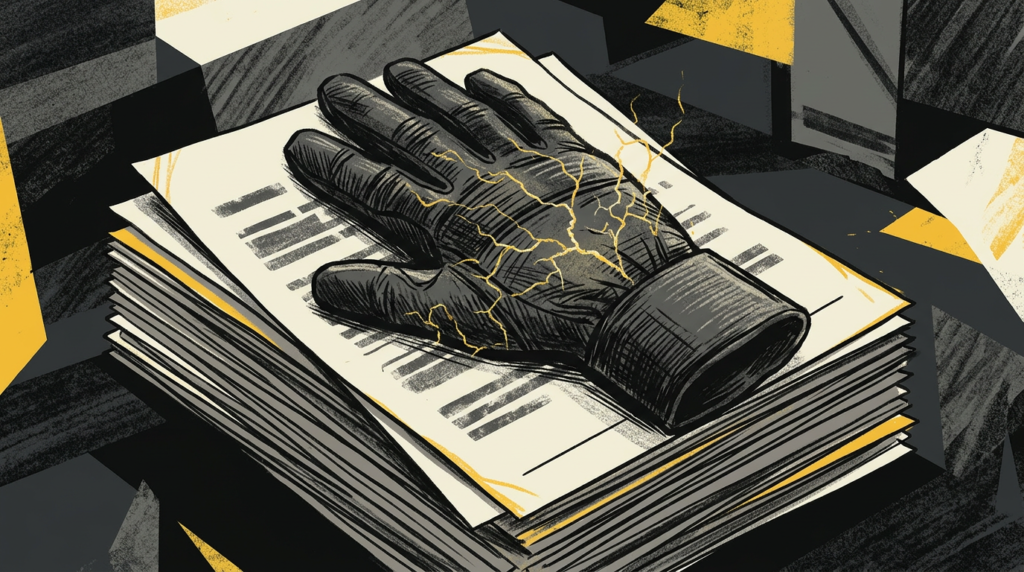
Immigration and Customs Enforcement is preparing to spend between $10 million and $20 million on a device called the CTG-5 G.L.O.V.E. — Generated Low Output Voltage Emitter — manufactured by Compliant Technologies LLC of Lexington, Kentucky. According to a Department of Homeland Security notice published this week, it resembles an ordinary patrol glove until an officer flips a switch, at which point pressing it against a person’s skin delivers what the manufacturer calls “rapid uncomfortable electrical pulses,” intended to inflict enough pain to force immediate compliance.
A NO-BID CONTRACT, AGAIN
DHS plans to award this as a firm, fixed-price contract with no competitive bidding process at all — the same pattern already documented in ICE’s own border wall contracts, where a rival firm sued over the lack of “genuine competitive opportunities.” The solicitation notice could go public as early as this Friday, with the contract expected to be finalized by the end of September and devices delivered by March 31, 2027. The notice lists Fort Benning, Georgia as the performance site but offers no explanation of what work would actually occur there or how devices would be distributed once purchased. The government hasn’t disclosed how many gloves it intends to buy, the cost per unit, or when officers would begin using them — though the Associated Press reports ICE is seeking thousands of the devices, to be issued both to Enforcement and Removal Operations, the division that carries out immigration arrests and deportations, and to Homeland Security Investigations.
THE MANUFACTURER’S OWN WARNING
Compliant Technologies markets the GLOVE as a safer alternative to other weapons for close physical encounters — but its own user manual states plainly that the technology is not risk-free, and that failing to follow its safety instructions “could cause injury or death.” Anyone using the device must be certified, and recertified every two years, to continue carrying it. This isn’t a fringe first-time product either: similar shock gloves from the same company have already been used in jails and police departments, including the Oklahoma County Jail, where a company distributor described the devices as capable of delivering shocks “at a rate of at least 210 volts” while insisting the technology “isn’t capable of causing injury” — a claim that sits uneasily next to the manufacturer’s own written warning that it can, under the wrong circumstances, cause injury or death.
THE TIMING THIS ARRIVES IN
This procurement isn’t happening in a vacuum. It comes as the administration presses ICE to hit a target of roughly 2,000 arrests per day, and as the agency already faces mounting scrutiny over what critics call increasingly aggressive and dangerous enforcement tactics — the same broader pattern documented across this newsletter’s coverage of the Delaney Hall hunger strike, the rising ICE custody death toll, the Prisciliano Trejo Ricano case, and the wrongful detention of witnesses to ICE’s own shootings. Layering a pain-compliance electrical device onto an enforcement apparatus already facing this level of documented, unresolved accountability concern is not a small addition — it’s handing agents a new tool specifically designed to inflict pain on contact, at the exact moment that agency’s existing conduct is under the most scrutiny it’s faced in years.
WHY THIS DESERVES REAL OVERSIGHT, NOT JUST A PRODUCT ANNOUNCEMENT
A firm-fixed-price, no-bid contract worth up to $20 million, for a device the manufacturer itself warns can cause injury or death, deployed to an agency already facing documented allegations of excessive force, unexplained in-custody deaths, and witness intimidation — with no public information yet on training standards, use-of-force policy, oversight mechanisms, or even how many devices are being purchased. That combination of scale, risk, and near-total absence of transparency is exactly the kind of procurement that deserves a formal congressional inquiry before a single glove reaches the field, not after the first incident report becomes public.