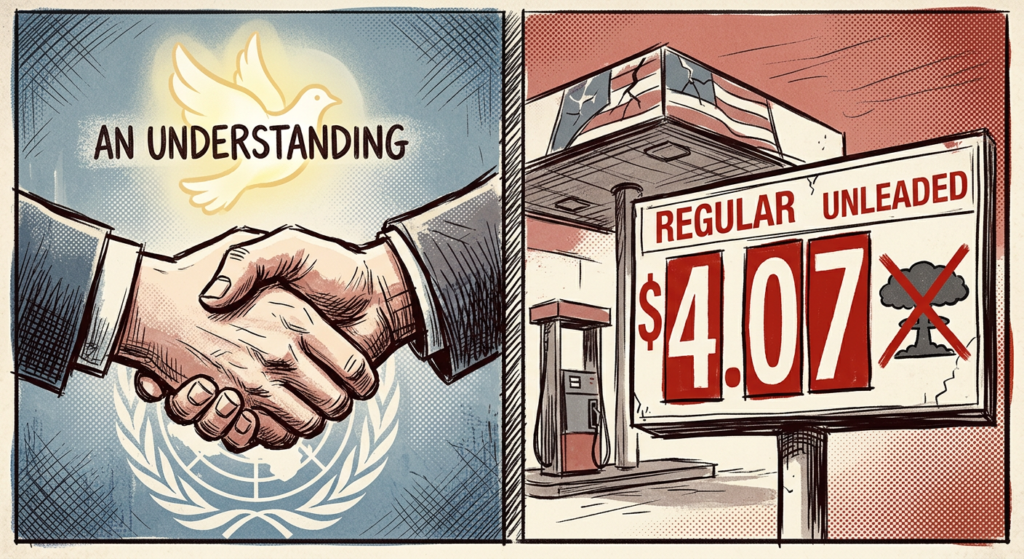
There’s a contradiction sitting in plain sight in Trump’s foreign policy this week, and it doesn’t require exaggeration to describe — just placing two of his own statements next to each other.
On Sunday, Trump ordered the Pentagon to “substantially reduce” the annual joint military exercises with South Korea, a treaty ally, hours before they were set to begin. His stated reasons: Seoul had declined to join the U.S. war effort against Iran, and — his words — “based on my very good relationship with Kim Jong Un, of North Korea,” the drills “send a signal that is totally inappropriate and hostile” to Pyongyang, which he described as “unthreatening and respectful” throughout his time in office.
Set aside for a moment that North Korea is an actual, declared nuclear power — one that tested a ballistic missile toward the sea just days before Trump’s announcement, in what experts read as protest of the very drills he then canceled. Set aside that Kim spent the weekend reaffirming deepening military ties with Vladimir Putin, having already sent North Korean troops and missiles to fight in Ukraine. Set aside that Kim hasn’t even bothered to publicly respond to Trump’s olive branch. The scaling-back happened anyway, justified by personal rapport with a man running one of the most heavily armed nuclear states on earth.
Now put that next to what Trump has been telling Americans about Iran — a country his own director of national intelligence, Tulsi Gabbard, testified in March was not rebuilding its nuclear enrichment capability after the 2025 strikes, and which the IAEA’s own director said in March showed “no evidence” of building a bomb before the current war even started. Trump publicly rejected that assessment. He escalated anyway. And now, with gas averaging $4.07 a gallon nationally — up 29% year-over-year, according to AAA, and a long way from the “under $2” he promised on the campaign trail — his message to Americans paying it is not an apology. It’s a lecture. “Remember that when you have to pay a little bit more, $4 — it’s okay,” he told a rally in Garden City. Weeks earlier, watching prices spike toward $3.47 mid-conflict, he called it “a little glitch.”
So the shape of it is this: with the nuclear-armed adversary, the posture is de-escalation, built on personal chemistry and a scaled-back military footprint. With the adversary his own intelligence chief said wasn’t building a weapon, the posture is an open-ended war Americans are told to help fund every time they fill a tank — a war that has, in the meantime, handed Iran real leverage over the Strait of Hormuz, one of the world’s most important oil chokepoints, which it hadn’t even closed before the fighting started.
It’s not that either move is inexplicable on its own. Trump has sought warmth with Kim since his first term, and there’s a real argument that cheaper, quieter diplomacy beats costly exercises Pyongyang treats as provocation. But “we’re easing up because a nuclear state might get upset” and “you need to eat the cost of a war against a state that wasn’t building a nuclear weapon” cannot both be the position of a foreign policy organized around nuclear risk. One of those two justifications is doing the work the other one claims to be doing.
The numbers don’t lie, even when the podium does.