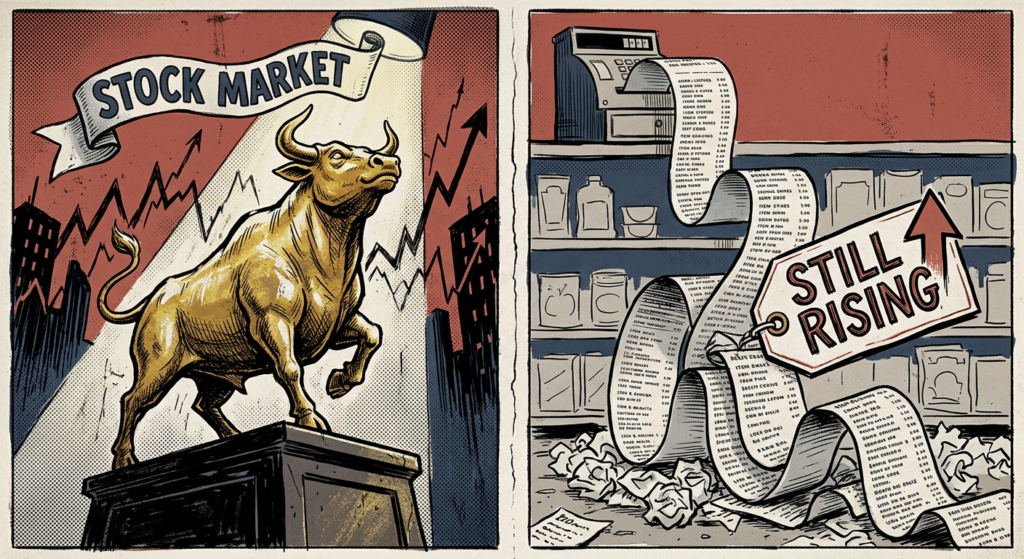
There’s a pattern to how the president talks about the economy, and it holds up under scrutiny: one claim is genuinely accurate, and almost everything built around it is inflated, cherry-picked, or flatly contradicted by the government’s own numbers.
What’s True: The Stock Market
Start with the one thing that checks out. Major U.S. equity indexes — the S&P 500, the Dow, the Nasdaq — have repeatedly hit record or near-record highs through 2026, driven substantially by an AI investment boom and a wave of blockbuster IPOs. Economists who are otherwise skeptical of the administration’s economic messaging concede this point without much hedging: “On the stock market, President Trump has a stronger factual basis. Major equity indexes have recently been at or close to record highs,” one analyst told Newsweek.
But even here, the caveat matters: stock performance and the health of the broader economy are not the same thing, and the same analysts note growing concentration risk — record highs sitting on top of a narrower and narrower base of AI-linked companies, not broad-based prosperity.
What’s False: “Prices Are Down”
This is where the claims stop matching the data. Trump has said repeatedly, in various forms — “prices are dropping fast,” “inflation is stopped,” “the food, the groceries, it’s all coming down” — that his administration has beaten inflation. The Bureau of Labor Statistics’ own numbers say otherwise.
As of July 2026, consumer prices were running at a 3.4% annual rate, not falling. Cumulative inflation from January 2025 (when Trump took office) through July 2026 was 4.34% — and going back to the late 1980s, only three presidential terms saw higher inflation at the same 18-month mark: Biden’s first term, George H.W. Bush’s term, and George W. Bush’s second term. Trump’s own first term, by comparison, ran cooler.
Grocery prices specifically are up roughly 2% under the current administration, not falling “rapidly” as claimed in a Detroit speech that fact-checkers flagged for containing “numerous false claims.” Trump’s July 2026 boast about the “fastest [inflation] drop in six years” was real for that single month — a 0.4% monthly CPI decline — but the accompanying claim that this meant inflation was now “way down” from when he took office was false; the annualized rate was still higher in June 2026 than it had been in January 2025. The one-month dip was traced by economists to falling energy prices after a ceasefire in the Iran conflict, not a durable trend.
There’s also a chart problem. In August 2026, Trump posted an inflation infographic on Truth Social that fact-checkers traced to an unreliable viral source; the actual BLS data it was supposedly illustrating showed the opposite of what the chart implied.
What’s Mixed: “The Economy” and the Deficit
GDP growth has actually been solid at points in 2026 — a revised 3.8% pace in the second quarter is a real, strong number. But the picture Trump paints around it doesn’t hold together. The federal deficit is not shrinking; the Congressional Budget Office projects it growing from $1.85 trillion in 2026 to $3.1 trillion by 2036, pushing total debt toward $56 trillion — well before accounting for the costs of the Iran conflict. Claims about slashing the trade deficit by “77 percent” rest on comparisons that don’t hold up against BEA export data.
Consumer sentiment reflects the gap between the White House’s framing and how people are actually experiencing the economy: confidence has slid, and in one CBS News/YouGov poll, Americans were more likely to describe the economy as “uncertain” or “struggling” than thriving. Only about a third approved of Trump’s economic stewardship in some 2026 polling, and disapproval of his handling of cost-of-living questions has run as high as 76% in others.
What’s Mixed: The Labor Market
This is the most nuanced piece, and it deserves more care than a flat “true” or “false.” Some individual jobs reports in 2026 genuinely beat expectations — January added 130,000 jobs against a forecast of 70,000, and White House officials weren’t wrong to tout that specific number. Unemployment at 4.1%–4.3% throughout much of 2026 isn’t a bad number by historical standards.
But the underlying trend, measured against the actual claim being made — that this is a hiring “boom” surpassing the prior administration — doesn’t hold. Job growth from January 2025 to January 2026 totaled 359,000, or about 0.2%. Biden’s final year added 1.2 million jobs, 0.8%, roughly four times the pace. By mid-2026, monthly job growth had slowed to around 20,000, and July 2026 actually saw payrolls shrink by 23,000. The employment-population ratio — the share of the population actually working — declined from 60.1% to 59.8% over the year. Unemployment, while historically unremarkable, rose from about 4.0% at the start of the term to as high as 4.4%–4.5% at points before settling back down. Economists characterized the labor market less as booming and more as “no-hire, no-fire” — stagnant rather than surging.
The Pattern
Laid side by side, the claims sort into three tiers, not two. The stock market claim is accurate and probably the most durable applause line in the president’s economic pitch, because it’s the one grounded in a number that moves in a single, checkable direction. The inflation and pricing claims are the most consistently and repeatedly false — not exaggerations of a real trend, but assertions of a decline that the government’s own data says isn’t happening. And the broader economy and labor market sit in between: real strength in some indicators (GDP, individual jobs reports), sitting alongside a weaker underlying trend than what’s being claimed, and a deficit and trade picture that doesn’t match the stated numbers at all.
The throughline across the false and mixed claims is the same move each time: take the one favorable data point in a given month, present it as the trend, and drop the twelve-month or year-over-year comparison that tells the fuller story. It’s why “the fastest one-month inflation drop in six years” and “inflation is way down since I took office” can both get said by the same person in the same season, even though the second one isn’t supported by the data that produced the first.